
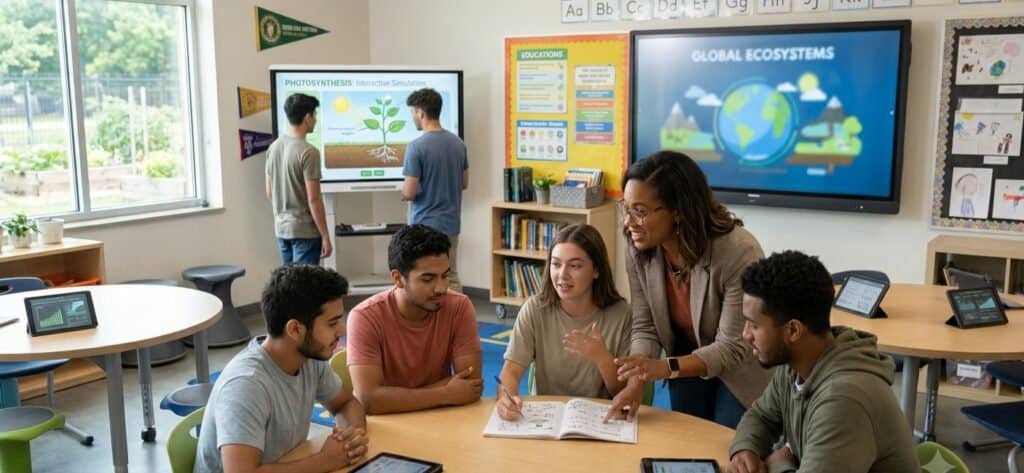
The future of education is not human versus technology. It is human enhanced by technology.

Artificial Intelligence will not replace teachers.
But it will expose institutions that refuse to change.
For months, headlines have warned that AI is transforming education.
Students are using it to complete assignments.
Professionals are relying on it to improve productivity.
Universities are experimenting with new teaching methods.
And educators everywhere are asking the same question.
“Will AI eventually replace teachers?”
It’s a reasonable concern.
But perhaps it is the wrong question.
The better question is:
“If AI can deliver information instantly, what becomes the real role of a teacher?”
That question will define the future of education.

Teaching Has Never Been About Delivering Information
For centuries, teachers have been recognised as the primary source of knowledge.
Students came to classrooms because that was where knowledge existed.
Today, information is everywhere.
Within seconds, Artificial Intelligence can explain complex theories, summarise research papers, translate languages, generate lesson plans and answer almost any factual question.
Knowledge has become abundant.
Understanding has not.
That changes everything.
The future of teaching will be less about delivering information and more about helping learners interpret it, question it and apply it wisely.

The Skills AI Cannot Easily Teach
Technology can answer questions.
It cannot replace curiosity.
It can generate content.
It cannot build character.
It can process information.
It cannot inspire confidence.
The qualities that define exceptional teachers have never been about possessing the most information.
They have always been about understanding people.
Helping learners overcome self-doubt.
Encouraging critical thinking.
Creating environments where ideas are challenged rather than simply accepted.
Ironically, as Artificial Intelligence becomes more capable, these deeply human qualities become even more valuable.

The Classroom Is Becoming Smarter
This does not mean AI has no place in education.
Quite the opposite.
Used responsibly, it can become one of the most powerful learning assistants ever created.
Imagine a classroom where routine assessments are automatically evaluated.
Learning materials are personalised for every student.
Teachers immediately identify learners who need additional support.
Administrative tasks take minutes instead of hours.
The result is not fewer teachers.
It is teachers with more time to teach.
More time to mentor.
More time to innovate.
Technology should remove repetitive work—not meaningful human interaction.

Institutions Must Teach Students to Work With AI
Preparing students for the future is no longer about deciding whether AI should be allowed in classrooms.
It is about ensuring learners know how to use it responsibly.
Future graduates will work alongside Artificial Intelligence in almost every profession.
The real competitive advantage will not be knowing how to avoid AI.
It will be knowing when to trust it.
When to question it.
And when human judgement must take precedence.
AI literacy is quickly becoming as important as digital literacy was a decade ago.
Institutions that embrace this reality will prepare graduates who are not only technologically confident but also ethically responsible.

The Future Belongs to Educators Who Embrace Change
Every major technological advancement has raised concerns about the future of education.
The internet.
Online learning.
Smartphones.
Virtual classrooms.
Artificial Intelligence is simply the latest chapter in that journey.
History shows that great teachers have never been replaced by technology.
They have adapted alongside it.
The educators who will have the greatest impact tomorrow will not be those who compete with Artificial Intelligence.
They will be those who use it to make learning more engaging, more personalised and more meaningful than ever before.
Because education has never been about information alone.
It has always been about transforming lives.
And that remains a uniquely human responsibility.

Key Takeaway
Artificial Intelligence will change how education is delivered, but it will not change why education exists. The future belongs to educators who combine technology with empathy, critical thinking and a deep commitment to helping learners grow.
