
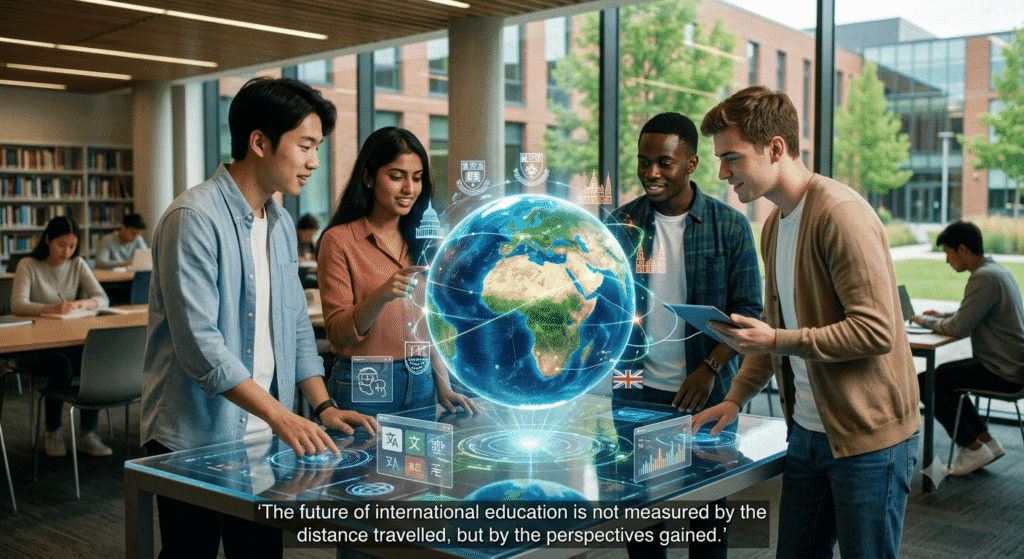
The future of global education is not about where you study. It is about how the world becomes your classroom.
For years, students asked one question.
“Which country should I study in?”
That question is still important.
But it is no longer the most important one.
The better question is:
“How can I build a truly global education?”
Those two questions may sound similar.
They are not.
One is about choosing a destination.
The other is about preparing for a future where learning, careers and opportunities are no longer limited by geography.
That future has already arrived.

International Education Is Being Redefined
For decades, studying abroad followed a familiar path.
Choose a country.
Apply to a university.
Earn a degree.
Return home—or build a career overseas.
While that journey continues for millions of students, the meaning of international education has evolved.
Today, students are no longer seeking only an overseas qualification.
They are seeking international exposure.
Global networks.
Cross-cultural experiences.
Research collaborations.
Industry connections.
And opportunities that prepare them to work in an increasingly interconnected world.
The destination still matters.
But the experience matters even more.

The World Has Become One Large Learning Ecosystem
Technology has fundamentally changed how learning happens.
A student in India can attend lectures delivered by professors in the United Kingdom.
Collaborate with classmates in Singapore.
Work on a live project with a company based in Germany.
And earn globally recognised certifications from institutions across the world.
Sometimes without leaving home.
Learning is no longer confined to a campus.
Nor is it confined to one country.
The classroom has expanded to include the world itself.
This is perhaps the biggest shift taking place in international education.
Global learning is becoming accessible to far more people than ever before.

Success Will Depend on Global Competence
Employers today operate in an international environment.
Teams are distributed across continents.
Customers come from different cultures.
Business decisions increasingly require global perspectives.
As a result, organisations are looking beyond academic qualifications.
They value people who can communicate across cultures.
Adapt to diverse environments.
Work with international teams.
And understand global markets.
These capabilities are not developed by travelling alone.
They are developed through meaningful exposure to different ideas, cultures and ways of thinking.
That is what international education should ultimately deliver.
Not just a foreign degree.
But a global mindset.

Choosing a University Is No Longer Enough
Students often spend months comparing university rankings.
Acceptance rates.
Tuition fees.
Scholarships.
These are important considerations.
But they should not be the only ones.
A better question to ask is:
“What opportunities will this university create beyond the classroom?”
Will it offer internships with global companies?
International exchange programmes?
Research opportunities?
Industry collaborations?
Entrepreneurship support?
Strong alumni networks?
The value of higher education increasingly lies in the ecosystem surrounding the university—not just the institution itself.
Choosing a university is important.
Choosing the right learning environment is even more important.

International Education Is Becoming More Inclusive
One of the most encouraging developments in recent years is that global education is no longer limited to those who can afford a traditional overseas degree.
Hybrid learning.
Short-term exchange programmes.
Online international collaborations.
Dual-degree pathways.
Global classrooms.
Virtual internships.
These models are making international exposure more accessible than ever before.
Students today have multiple pathways to build a global profile.
The future belongs to those who are willing to explore them.

Looking Beyond Borders
Perhaps the biggest shift is not educational at all.
It is philosophical.
The purpose of international education is no longer simply to study in another country.
It is to learn from the world.
The most successful learners of tomorrow will not be defined by the passport they hold or the destination they choose.
They will be defined by their ability to think globally, collaborate across cultures and adapt to opportunities wherever they arise.
Because in an interconnected world, education should not prepare students for one country.
It should prepare them for the world.

Key Takeaway
International education is no longer defined by crossing borders. Its true value lies in developing a global mindset, building meaningful international experiences and preparing learners to thrive in an interconnected world.
